Teaching & Knowledge Sharing

Mentorship, hands-on training, and academic research programs in computational biology & bioinformatics

3 Academic Programs
4 Months Internship Duration
7 Modules Advanced Internship 4.0
110+ Learners Trained
Teaching Philosophy

My Approach to Education

How I teach, mentor, and empower early-career computational researchers

I use hands-on, problem-solving approaches to teach bioinformatics, bridging theory and practical workflows with real datasets—molecular docking, network pharmacology, DFT descriptors, and cancer transcriptomics—so researchers learn why a pipeline matters before how to run it. Through BioPC, I mentor a self-sufficient community of computational biologists across Bangladesh and beyond who independently design experiments, analyze biological systems, and publish high-impact research.

Programs & Courses

Educational & Research Training Activities

Internship programs, specialized courses, and upcoming training initiatives offered through BioPC
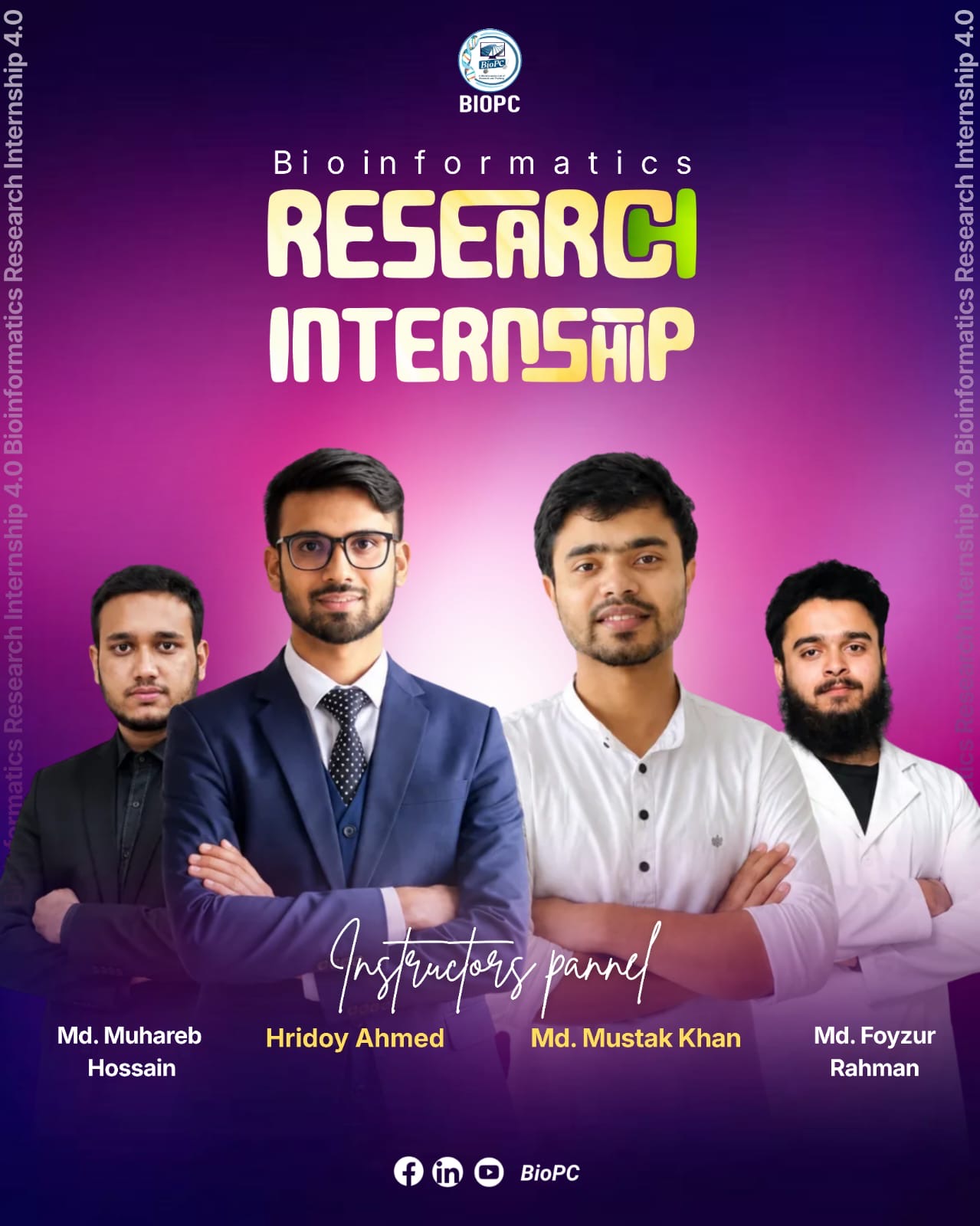
Featured • Advanced Research Internship Registration Ongoing
Deadline Alert
20 September 2026
Visit Internship Portal Apply / Register Online View Official Poster
Duration: 4 Months Intensive
Level: All
Format: Online / Interactive
Organizer: BioPC Lab
Cohort 4.0 • 4-Month Research Track

Bioinformatics Research Internship 4.0

Role: Internship Program Lead & Instructor Organization: BioPC — A Bioinformatics Lab of Research & Training

Bioinformatics Research Internship 4.0 is an intensive, multi-disciplinary 4-month advanced research program created to train aspiring computational biologists, graduate scholars, and researchers. Building on the success of its flagship predecessor — the Research Traineeship Program 3.0 (where Md. Mustak Khan served as one of the instructors mentoring over 80+ participants) — the 4.0 curriculum takes participants through modern computational drug design, quantum chemical DFT modeling, immunoinformatics vaccine development, cancer transcriptomics, and publication-ready manuscript writing.

Comprehensive 7-Module Curriculum

Click on any module below to inspect the topics and research tools covered:

01

Module 1 — Introduction to Bioinformatics and Biological Databases

  • Introduction to bioinformatics: scope and applications in drug discovery
  • Biological data types: DNA, RNA, and protein sequences
  • Sequence data retrieval and database overview
  • Key bioinformatics tools and workflows for molecular analysis
Tools Used: NCBI UniProt PDB BLAST
Deliverable: Annotated sequence/database report
02

Module 2 — Computer-Aided Drug Design (CADD)

  • Drug discovery pipeline and target identification
  • Structure-based and ligand-based drug design principles
  • Protein structure analysis and chemical representation
  • Ligand preparation and chemical structure drawing
  • Drug-likeness evaluation and physicochemical profiling
  • ADME and toxicity prediction
  • Protein structure modeling, AlphaFold prediction, and model validation
  • Pharmacophore modeling for lead identification
  • Molecular docking and protein–ligand interaction analysis
  • Interpretation of docking results
  • Molecular dynamics and flexibility analysis of protein–ligand complexes
Tools Used: AlphaFold AutoDock Vina Biovia Discover Studio AdmetLab 3.0 Protox 3.0
Deliverable: Docking + ADMET report on a candidate compound
03

Module 3 — Network Pharmacology

  • Concepts of network and systems pharmacology
  • Multitarget drug discovery strategies
  • Identification of bioactive compounds from natural sources (IMPPAT 2.0, Dr. Duke's Database)
  • Prediction of compound–target interactions and disease-associated targets
  • Protein–protein interaction (PPI) network construction and analysis
  • Hub target identification using network topology
  • Functional enrichment (Gene Ontology, ShinyGO) and pathway (KEGG) analysis
  • Construction of drug–target, target–pathway, and integrated drug–target–pathway networks
  • Docking validation of key targets
Tools Used: Venny 2.0 ShinyGO IMPPAT 2.0 Dr. Duke's DB GeneCards STRING Cytoscape Swiss Drug Design
Deliverable: Compound-disease-target network diagram + pathway report
04

Module 4 — Density Functional Theory (DFT)

  • Build and optimize molecular structures
  • Perform DFT calculations using Gaussian
  • Analyze HOMO-LUMO
  • Perform IR, Raman & NMR calculations
  • Interpret computational results
  • Prepare DFT results for research publications
Tools Used: Gaussian GaussView Avogadro
Deliverable: DFT analysis report with spectral interpretation
05

Module 5 — Vaccine Design

  • Fundamental concepts of vaccine immunology
  • Introduction to vaccines and major vaccine types
  • Comprehensive vaccine design workflow
  • Target virus identification and selection
  • Target protein identification and sequence retrieval
  • Physicochemical characterization of target proteins
  • T-cell and B-cell epitope prediction
  • Epitope screening based on antigenicity, toxicity, allergenicity, conservancy, and sequence homology
  • Multi-epitope vaccine sequence construction
  • Physicochemical characterization of the designed vaccine
  • Secondary and tertiary structure prediction and validation
  • Protein–protein molecular docking and interaction analysis
Tools Used: IEDB VaxiJen AllerTOP ProtParam AlphaFold ClusPro AutoDock Vina C-ImmSim
Deliverable: Multi-epitope vaccine construct workflow, validation & molecular docking analysis report
06

Module 6 — Cancer Bioinformatics

  • Foundations of Cancer Biology
  • Transcriptional Expression Profiling
  • Proteomic Expression Assessment
  • Survival Prognosis Evaluation
  • Genetic Alteration and DNA Methylation Profiling
  • Tumor Mutational Burden, Microsatellite Instability, and Immune Checkpoint Correlation
  • Immune Cell Infiltration Assessment
  • Protein–Protein Interaction and Functional Enrichment Mapping
Tools Used: cBioPortal KM Plotter Human Protein Atlas GEPIA 2 UALCAN GREIN STRING ShinyGO
Deliverable: Multi-omics cancer biomarker profiling, immune infiltration & survival prognosis report
07

Module 7 — Bioinformatics-Based Manuscript Writing

  • Research paper structure & IMRaD
  • Literature review & research gap identification
  • Scientific & academic writing
  • Introduction, Methods, Results & Discussion
  • Computational results writing
  • Tables, figures & scientific data presentation
  • Citation & reference management
  • Plagiarism & research ethics
  • Journal selection & manuscript formatting
  • Cover letter & reviewer response
  • Guided manuscript writing project
Tools Used: Zotero SciSpace QuillBot Grammarly Turnitin Mendeley
Deliverable: Draft manuscript section based on internship project

Expected Internship Competencies

  • Master end-to-end computational drug design, docking, ADMET, and quantum DFT descriptors
  • Construct network pharmacology and reverse vaccinology multi-epitope vaccine workflows
  • Extract, process, and interpret cancer transcriptomic profiles from international datasets (TCGA/GEO)
  • Formulate, draft, and format publishable manuscripts tailored for high-impact scientific journals

Who Should Apply

Undergraduate Students (Biochem, Biotech, Pharmacy) Graduate Students & Postgraduate Researchers Any Life Science Students & Researchers
Bioinformatics • Intermediate Course Completed · Feb 2026 – Mar 2026
In Silico Innovation: Computer-Aided Drug Design and Network Pharmacology — Course Banner
Download Syllabus (PDF) Express Interest in Future Cohorts
Timeline: Feb 2026 – Mar 2026
Level: Intermediate Course
Enrolled: 30+ Participants Mentored

In Silico Innovation: Computer-Aided Drug Design and Network Pharmacology

Role: Lead Instructor Platform: BioPC — Bioinformatics Lab of Research & Training Completed: Feb – Mar 2026

A focused intermediate-level training course designed to equip life science and pharmacy students with practical, hands-on computational drug discovery skills. Across 4 intensive modules, participants worked with biological databases, executed ligand-target docking workflows with AutoDock Vina, conducted ADMET pharmacokinetic profiling, and mapped complex plant-phytochemical target interactomes using Cytoscape. Over 30+ students and researchers across Bangladesh completed hands-on research assignments and project presentations.

4 Core Course Modules

Module 1: Intro to CADD & Biological Databases Module 2: Ligand- & Structure-Based Drug Design Module 3: Network Pharmacology & Target Mapping Module 4: ADMET Profiling & Molecular Visualization

Course Outcomes & Achievements

  • 30+ students gained direct hands-on competence in molecular docking using AutoDock Vina and PyRx
  • Participants constructed multi-target pharmacology networks in Cytoscape and identified key hub proteins
  • Researchers learned systematic ADMET property evaluation and pharmacokinetic filtering for lead candidates

Participant Demographics

Undergraduate & Graduate Biochemistry Students Pharmacy & Biotechnology Researchers Natural Product & Phytomedicine Investigators

Participant Feedback

"The course gave me a clear understanding of how computational biology can be applied to real drug discovery problems. I completed my first molecular docking project independently after just 3 modules."

— Payel Chowdhury, Course Participant · BioPC 2026

"Instructor Mustak's approach is very hands-on. Every session included a real dataset. I walked away with skills I could apply in my own research immediately."

— Maria Opsora, Course Participant · BioPC 2026

Bioinformatics • Research Traineeship Completed · Cohort 3.0
Research Traineeship Program 3.0 — BioPC Banner
Cohort: Cohort 3.0
Participants: 80+ Researchers Mentored
Role: Program Instructor
Platform: BioPC Lab
Cohort 3.0 • Flagship Predecessor to Internship 4.0

Research Traineeship Program 3.0

Role: Program Instructor Platform: BioPC — Bioinformatics Lab of Research & Training Mentored: 80+ Participants

The Research Traineeship Program 3.0 was an intensive research training initiative and the direct predecessor to the Bioinformatics Research Internship 4.0. Serving as one of the core instructors, Md. Mustak Khan guided over 80+ enrolled life science scholars, pharmacy graduates, and early-career researchers across Bangladesh through specialized practical pipelines in computer-aided drug design, AlphaFold structural modeling, reverse vaccinology, and scientific manuscript development.

Core Training Tracks Mentored

Drug Design Track (AutoDock Vina & PyRx) AlphaFold Structure Prediction & Validation CAVD & Vaccine Design Track ADMET Pharmacokinetics (AdmetLab 3.0, Protox 3.0) Publication & Manuscript Preparation Track

Program Impact & Achievements

  • Successfully trained and mentored 80+ aspiring computational researchers and students across Bangladesh
  • Equipped learners with independent execution capabilities in molecular docking, protein modeling, and ADMET analysis
  • Alumni successfully progressed to advanced research initiatives, thesis defenses, and peer-reviewed journal manuscript drafting

Alumna Feedback

"The hands-on training on AlphaFold structure prediction, AutoDock Vina, and ADMET profiling gave me the exact workflow to screen candidate compounds and interpret binding affinities with complete confidence."

— Mahfuja Akter, Program Alumna · Drug Design Track (Cohort 3.0)
About the Instructor

Meet Your Instructor

Academic background, specialized domains, and mentorship philosophy

Md. Mustak Khan — Instructor

Md. Mustak Khan

Instructor • BioPC Bioinformatics Lab • University of Chittagong

Researcher specializing in phytomedicine, molecular biology, and computational drug discovery. Completed his MS thesis on Houttuynia cordata phytochemicals integrating molecular docking with C. elegans in vivo assays (37 °C thermal survival, thrashing locomotion, solid-media lifespan curves, and brood size toxicity checks). As a founding member and instructor at BioPC, he directs research training initiatives, organizes workshops, and has trained over 110+ researchers across Bangladesh in computational drug design, network pharmacology, and multi-omics data analysis across programs including the Research Traineeship Program 3.0 (80+ participants), In Silico Innovation (30+ participants), and the active Bioinformatics Research Internship 4.0.

Molecular Docking (AutoDock Vina) Network Pharmacology Density Functional Theory (DFT) Vaccine Informatics (CAVD) Cancer Bioinformatics C. elegans In Vivo Assays Manuscript Writing
View Full Academic Profile →